Thursday, December 17, 2015

Builders Tell Buyers: Plan For Higher Home Prices In 2016

National Association of Home Builders: Housing Market Index declines in December 2015
2016 NEW HOME PRICES TO RISE, SAY BUILDERS

Home builders remain bullish on U.S. housing.

With mortgage rates low and U.S. rents rising, today's homebuilders expect 2016 to be another strong year for housing. Builder confidence is at levels not seen since last decade.

As measured by the National Association of Homebuilders' Housing Market Index (HMI), homebuilder sentiment reads 61 out of 100 -- the third-highest reading of the year and a steady three points higher than the index's 12-month average.

Builders are excited for the 2016 housing market -- and for good reason.

The combination of low mortgage rates, rising rents, and an abundance of loans for buyers with less than 20% down have changed the math of "Should I rent or should I buy?".

More than 6 million homes are expected to sell in 2016, which would be the most in 10 years. And demand for homes is moving prices up.

The best "deals" in new construction housing may be the ones you find today.

HOMEBUILDER CONFIDENCE KEEPS CLIMBING

Once monthly, the National Association of Homebuilders (NAHB) surveys its members on current housing market conditions; and their outlook for the housing market's future.

The results are compiled into the Housing Market Index.

Informally, the report is called the "homebuilder sentiment survey" and it reflects homebuilder attitudes about the nation's single-family, new construction housing market.

The index is relevant because home builders tend to witness the psychological changes of "Main Street" long before they're revealed to economists.

There are a multitude of instances in which the NAHB Housing Market Index has hinted at what's next for U.S. housing before the actual home data revealed itself.

One prominent example occurred last decade and foreshadowed the 2007-2011 housing market downturn.

Recall that mid-decade, U.S. housing was expanding quickly and home values were making new, all-time highs. Mortgage money was loose, as was underwriting. Homeownership rates were near all-time highs.

Home builder confidence, though, was slipping. Through the last two quarters of 2005, sentiment dropped 21%. And, remember -- this was before the market turned. Values were still rising!

By 2009, the HMI had dropped from an all-time high of 77 to an all-time low of 6.

Today, sentiment is a 61.

In the NAHB Housing Market Index, 50 is the inflection point in the index between "good" conditions and "poor" ones; and December's reading is the seventh straight month in which the HMI has read north of 60.

This hasn't happened in 10 years.

Buoyed by low mortgage rates and huge demand from buyers -- first-timers and repeat buyers alike -- today's home builders believe the housing market is "good".

Buyers should expect fewer price concessions in 2016, and fewer free upgrades. Homes are selling well without such incentives.

WILL U.S. HOME BUYERS GET "PRICED OUT" IN 2016?

The NAHB Housing Market Index is a composite survey. It's results are based on three distinct questions posed to homebuilder trade group members.

Each question polls a separate facet of a homebuilder's business.

The monthly readings, as reported by the homebuilder trade group :

Current home sales activity : Reading of 66 (+4 from one year ago)
Home sales activity for the next six months : Reading of 67 (+3 from one year ago)
Buyer foot traffic : Reading of 46 (+0 from one year ago)
For students of housing, it's the index's foot traffic reading which may be most relevant.

Current home sales activity and projected home sales activity are both near 10-year bests, but that's because demand for new homes is strong.

Buyer foot traffic is above its 12-month average and, although many buyers don't know specifically what a mortgage is, they do know that rents are up and squeezing their budget.

Owning a home is cheaper than renting in many U.S. cities now.

Source: The Mortgage Reports, Dan Green
http://themortgagereports.com/18675/nahb-housing-market-index-mortgage-rates-loans?utm_source=feedburner&utm_medium=feed&utm_campaign=Feed%3A+TheMortgageReports+%28The+Mortgage+Reports%29

Wednesday, December 16, 2015

Important Clauses In Your Real Estate Contract


You have just found your dream house, and would like to buy it. What to do now?

When dealing with real estate matters, the law is clear: everything has to be in writing. Thus, you will need a sales contract, which will spell out all of the terms, conditions and special requirements you may (or will) need in order to conclude the transaction and go to closing (settlement) on the house.

If there is no real estate agent involved, your attorney should be able to assist you in preparing the contract offer. If there is a real estate agent, you can get a form sales contract from the agent. In fact, the agent should be able to assist you in preparing the document for presentation to the seller, although your attorney should review it before you sign.

Typically, the buyer makes a written offer to the seller. The seller has three alternatives:

1. The contract can be accepted;

2. The contract can be rejected in its entirety, or

3. The contract offer will be countered, with different terms.

It is rare that the seller will opt for alternatives one or two; in most cases, the potential buyer will receive a counter-offer. Then, the buyer has the same three alternatives.

There are certain things which must be included in any sales contract.


  • The property must be clearly identified, preferably by street address.


  • The contract must be contingent upon your obtaining financing. You should allow yourself some time -- usually 30-45 days -- in which to make application from a mortgage lender and get a written commitment that you have been approved for the loan. Under the new Consumer Financial Protection Bureau (CFPB), it will take more time, so you may want to give yourself up to 60 days in which to finalize the deal.


  • Unless you are an experienced contractor, it is advisable that you make the contract contingent on your obtaining a satisfactory home inspection. You should give yourself 5-7 days after the contract is signed to have the property inspected. If you are not satisfied for any reason after you receive a written report from the inspector, you should have the right to terminate the contract, and get back your earnest money deposit.


  • How much earnest money should you put up when you sign the sales contract? There is no magic formula and no law dictating a certain percentage of the purchase price. When you sign a contract, in order to make it a valid, legal document, the buyer should put up some money as a good faith earnest money deposit. These funds will be held by the real estate broker or the settlement attorney until settlement takes or until either the buyer is entitled to a return of the deposit (because the contingencies cannot be met) or the buyer is in breach of the contract, in which case the moneys would go to the seller.


Real estate agents and brokers usually ask that the buyer put up 10 percent of the purchase price as this earnest money deposit. However, buyers can put up more or less, so long as the seller agrees with the amount. Indeed, in many real estate contracts, the earnest money deposit consists only of a promissory note signed by the buyer, to be redeemed at the settlement itself.

Buyers should understand that although everything in real estate is negotiable, the earnest money should be large enough to convince the seller you are seriously interested in going forward with the purchase. I usually recommend this deposit be approximately five percent of the purchase price.


  • Finally, the contract should be contingent upon the buyer obtaining -- no later than the date of settlement -- a "termite" letter. This is a report from a licensed pest inspection company indicating that the house is free and clear of termites and other wood-boring infestation. Some contracts require the seller to obtain and pay for this report; other contracts put the burden on the purchaser. Either way, this is a critical report which all buyers should receive -- and carefully review -- before settlement is completed. Obviously, in a high-rise condo, such a termite letter would not be required.


Many of these contingencies are time-sensitive. You -- as buyer -- have so many days in which to get financing and so many days in which to complete the home inspection. Mark your calendar with these due dates, and make sure you act on these contingencies before the time has expired. Otherwise, it will be too late and you will be legally bound to comply with the terms of the contract, and proceed to settlement.

Source: RealtyTimes, Benny L. Kass
http://realtytimes.com/consumeradvice/buyersadvice1/item/40804-20151211-important-clauses-in-your-real-estate-contract

Monday, December 14, 2015

How to Home In on the Right Neighborhood for You


relaxing-at-homeLocation, location, location. As the real estate agents say, it’s the No. 1 attribute in real estate. But it’s not just true when it comes to assessing a home’s value—it’s also a key factor in determining your future happiness, according to Katherine Loflin, a consultant in the new field of “placemaking.”

Loflin, who has a new book out this month—“Place Match: The City Doctor’s Guide to Finding Where You Belong”—talked to us about how to find your perfect community, and why that’s so important.

Q: Why is living in the right place so important?

You live in a home, but your life happens in a place. Both are important to us living our best lives. From 2008 to 2010, I was the lead consultant in research that examined what makes people love where they live. The Knight Soul of the Community project in partnership with Gallup studied 26 U.S. diverse communities, nearly 43,000 people. The findings were remarkable. In every place studied, the same things came up as critical for creating quality-of-life places: People want a place they find beautiful, with opportunities that they enjoy, in an environment that feels welcoming. And places where residents were happy with those qualities experienced higher local economic growth.

Q: You compare finding the right place to finding the right romantic partner. Why?

Through my speeches and a couple of TEDx talks, I’d been teaching the science behind what makes people love where they live. Yet at the same time, personally I was losing my love for my own place and in the beginning stages of a difficult marital divorce. I had never felt more like a hypocrite!

During one speech I was making in 2012, I went rogue and made an unplanned comparison that mirrored my own life at the time about how certain places may not be a perfect match for everybody—a lot like marriage. To say it was a “aha moment” is an understatement. Simultaneously, I noticed a dawning awareness in the crowd. When I talk about dating your place, committing to it, or leaving it in a relationship context, the concepts just make sense to people and give them a framework for making decisions about where to live.

Q: What advice do you have for people who want to find the right place?

First, create a wish list for the place you want. What kind of place are you seeking, given where you are in your life—kid-friendly, retiree destination, walkable, cultural offerings, quintessential experiences that you crave? Just as we know the kind of person we are seeking as a partner, we should know the kind of place where we would thrive.

Next, spend some time there—date your place. And just like you should probably see your potential life partner with the flu before you marry, you have to learn about the challenges of the place. What are the issues the place is facing? Do you love it enough to want to help, or at least accept it, warts and all?

Q: What are the most common mistakes when choosing where to live?

Don’t move there based solely on vacation experience(s) there. Have you ever heard someone say, “It’s a great place to visit, but I wouldn’t want to live there”? That’s a real thing. Second, don’t make the mistake of thinking this is about “good” and “bad” places. Just like when you’re dating, it’s about your compatibility. While all people like places that are welcoming, different places do this different ways. In some places, welcoming means people hug you when they meet you. Some people love that, others not so much.

Q: How has this understanding of place affected the buying and selling of real estate?

One real estate journalist told me, “Today, houses are everywhere. We have to now also sell places. That’s what people are asking about more than the number of bedrooms.” Even when local economies failed at the end of the last decade, people who loved where they lived talked about taking solace in their place. As people felt disillusioned over the loss of a job that they had dedicated much of their life to, their values shifted. “I will no longer live to work, but work to live” was a common refrain I heard during that time.

Q: What are the most surprising stories you’ve heard about someone’s search for the right place?

The stories that always drop jaws are ones where I talk about people just “showing up” in a city or town they want to live in and figuring out the job and place to live once they get there. It is definitely a different strategy than what guided our parents, when absolutely everything 100% was dictated by the job.

Q: How can people who love their place change it?

There are always stories of a place going from unknown or declining to a thriving destination—like the upstart chef who couldn’t afford to open his own restaurant except in a small town. Then he took advantage of its rural location to help local farmers by creating a farm-to-table component of the restaurant, which further helped it succeed. And in a few short years, the place is transformed.

Source: Realtor.com, Judy Dutton
http://www.realtor.com/advice/buy/right-neighborhood-for-you/?iid=rdc_news_hp_carousel_theLatest

Sunday, December 13, 2015

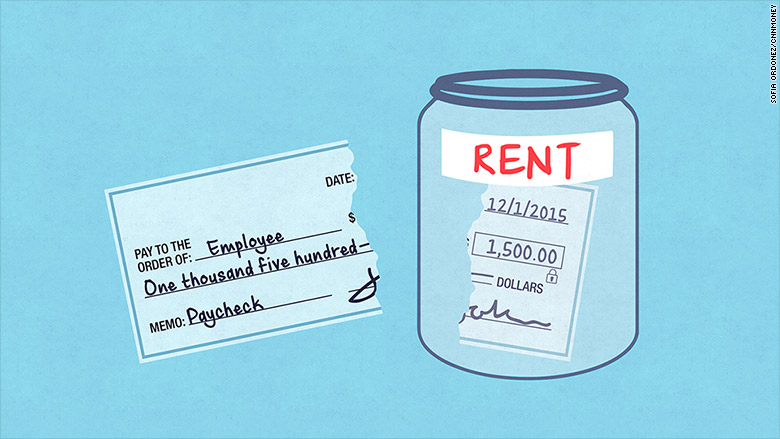
Half of all renters can't afford the rent


This article is a little worrisome for me. I live and conduct my real estate business here in the Silicon Valley, which by the way is among the highest rents in the country. The fact that half of renters can afford the rent tells me there is a large segment of the population that no only are struggling to afford the rent, but also they are unable save enough money for that all important down payment on their first home.

Nearly half of renters in the U.S. are struggling to afford their monthly payments.

cant afford rentExperts generally recommend keeping your housing costs around 30% of your monthly income. But the number of "cost-burdened" tenants -- those who spend more than 30% of their income on rent -- rose to 21.3 million people last year, according to Harvard's Joint Center for Housing Studies.

Of those, more than 26% are "severely cost burdened" and spend more than half of their income to cover rent.

Here's the problem: rents are increasing much faster than wages. Inflation-adjusted rents increased 7% from 2001-2014 while household incomes dropped 9%, the report showed. At the same time, rising demand for rental units has pushed the national vacancy rate to a 30-year low, driving prices even higher.

"These trends have led to record numbers of renters paying excessive amounts of income for housing, with little prospect for meaningful improvement," the report said. The median rent for a new apartment climbed to $1,372 last year, a 26% increase from 2012.

While low-income households are the most likely to have a hard time making ends meet, middle-income households are increasingly struggling to make rent. The number of burdened households with an income of $45,000-$74,999 jumped to 21% in 2014 from 12% in 2001.

Builders have ramped up construction recently, but supply hasn't kept up with demand and new units tend to focus on the higher end of the market. Land costs and regulations make building expensive, and developers need to make a return on their investment.

Higher rents put a strain on household budgets. Families that paid more than half of their income on rent spent 38% less on food last year and 55% less on health care, according to the report.

The 2008 housing crash has led to record rental demand with 37% of households renting in 2014 -- the highest level in more than 45 years.

Source: CNN Money, Kathryn Vasel
http://money.cnn.com/2015/12/09/real_estate/renters-cant-afford-rent/index.html?section=money_realestate

Saturday, December 12, 2015

2016 Women's Council of Realtors Installation Event at Claudine's Place

Congratulations to the 2016 WCR President Claudine Tuazon Rydquist and the board members. Wishing you a very successful year.

As the outgoing President, I sincerely would like to Thank the 2014 and 2015 WCR Board Members.

I would also like to Thank SILVAR, SCCAOR, AREAA, NHORA, FAREPA, CREAA, WCR members and Business Partners. I appreciate everyone's support and trust over the past two years.

The WCR Santa Network has once again been recognized as one of the best organization in Silicon Valley.

In addition, a special Thanks to Cecily Tippery, WCR State President and Michelle Pagsolingan Perez; DVP for your support and attendance of our 2016 installation.