Showing posts with label wealthy. Show all posts

Wednesday, September 28, 2016

Why that million-dollar home is sitting on the market


By the time it sold last week for $4.8 million, a six-bedroom lakefront mansion in Winnetka had been on the market for most of the past six years and the sellers had already moved to California.

They're not the only high-end sellers who've had to wait: Luxury-priced homes all over the city and suburbs are taking a long time to sell.

Homes priced at $1 million and up are selling slower on average this year in 18 of 22 expensive Chicago neighborhoods and suburbs, according to Midwest Real Estate Data. Luxury homes are selling faster in just four locations: Streeterville in the city and in the suburbs of Evanston, Glencoe and Highland Park.

Agents blame an oversupply in the price range, reluctance of homeowners to head for the suburbs and the protracted struggle to clean up the financial mess in Illinois and Chicago.

"We've got these high property taxes, sales taxes and income taxes, and these crazy pension problems we'll never be able to pay for," said John Phillips, a Jameson Sotheby's International Realty agent in Winnetka. "Why buy an expensive house when you can buy a smaller one and use the rest of the money on something else, like a second home in another state?"

In Deerfield, where the slowdown has been steepest, the average home that went for $1 million or more in the 12 months ended July 31 sold in 233 days, up from 144 in the year-earlier period, MRED's data show.

Househunters in Deerfield "are seeing they can get a better deal in Highland Park," said Margie Brooks, a Baird & Warner agent with high-end listings in both Deerfield and Highland Park, to the east. "They get more of a downtown and the beaches."

Highland Park's better deals are available in part because so many homes are for sale there, which leads to price wars. There are 91 homes on the market at $1 million-plus in Highland Park, almost twice the 46 upper-end homes that sold in the previous year.

That should mean that Highland Park's high-end homes would be selling slower as well, but they're not.

In the city, the biggest slowdown is in North Center, where $1 million-and-up homes are selling in an average of 116 days this year, up 41 percent from the year before. There were 122 sales last year and 116 this year.

"It's because there's so much supply on the market," said Sean Glascott, an @properties agent. He sold a newly built home on Waveland Avenue in North Center that was on the market for 18 months before selling in June for slightly over $1.8 million.

While the 5,000-square-foot home was under construction, "there were 10 other homes being built in the immediate area, all within a couple hundred thousand dollars of ours, and we knew about more that were coming," Glascott said.

SALES UP

Although the time it takes to sell million-dollar-plus homes has lengthened this year, more of them are selling. This year, a combined 1,711 high-end homes have sold in the 22 areas, according to MRED, an increase of 3 percent from a year earlier.

Buyers may be coming for the prices. The Waveland Avenue home that Glascott sold started out at just over $2 million but eventually went for 13 percent less.

"We knew it was time to let this thing go before we were competing with 20 houses," he said.

Sales have slowed in city neighborhoods from the South Loop up to Lincoln Square. Only Streeterville has speeded up, but not by much. Million-dollar homes are selling in 140 days, down from 143 last year. But at the same time, the number of Streeterville sales is down 20 percent at 75 this year.

In the market overall, homes at all prices are selling faster than they were a year ago, according to MRED. While a single regional figure is not available that corresponds with the time period in the million-dollar study, MRED's end-of-August report showed that everywhere but Lake County had homes selling faster year-to-date than in the first eight months of 2015. In Lake County, they were selling 4 percent slower.

Evanston stands out as the bright spot for million-dollar sellers. Luxury homes are selling 35 percent faster—in 92 days this year, down from 142—and the number of sales, 45, is up 20 percent from last year.

"Evanston has always been a mini-Chicago," said Debbie Magnusen, an @properties agent who works there. "It has restaurants and culture; and if you want to go into the city easily, you can."

'THEY REALLY DON'T WANT TO GO FARTHER NORTH'

That's always been true, but Magnusen said it's become even more important in recent years as two-earner couples try to stay close to job centers and raise kids at the same time.

"They really don't want to go farther north," said Magnusen, who said listings in next-door Wilmette are getting considerably fewer showings than those in Evanston. High-end sales are taking 63 percent longer in Wilmette, an average of 101 days, up from 62 last year.

Agents in other, farther north suburbs have been saying the same recently: that younger affluent adults don't want to make longer commutes.

Phillips, the Jameson Sotheby's agent, said keeping to a shorter commute is a pragmatic choice the younger generation is making, in part because in these days of slow price recovery,

When home values "were going up 4 or 5 percent a year, you had the fun of living in it and made money at the end," Phillips said. "Now you can have a lot more fun with that money somewhere else, like Florida."

Source: Crain's Chicago Business, Dennis Rodkin
http://www.chicagobusiness.com/realestate/20160913/CRED0701/160919978/why-that-million-dollar-home-is-sitting-on-the-market

Friday, May 20, 2016

Silicon Valley Mansions Linger on Market in Real Estate Slowdown


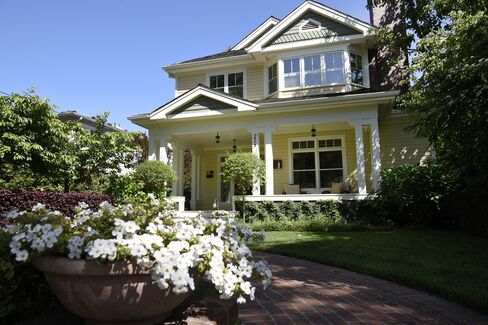
A custom-built home in Palo Alto.
A custom-built home in the heart of California’s Silicon Valley had its price cut by $500,000 last week after sitting on the market since the end of March -- a move that would’ve been almost unfathomable a year ago and a signal that frenzied demand has peaked.

The six-bedroom, five-bath house in Palo Alto -- located blocks from Stanford University and the homes of Google co-founder Larry Page and Steve Jobs’s widow, Laurene Powell Jobs -- is now listed for $7.5 million. It joins a growing inventory of high-end homes in the area that are taking longer to sell.

“We’ve recently noticed a slowdown,” Jack Woodson, who works at Alain Pinel Realtors in nearby Menlo Park, said on a tour of the house in the Old Palo Alto neighborhood. “Buyers are taking more time to decide about making offers.”

Silicon Valley, the most-expensive U.S. housing market, is seeing a pullback by the wealthiest homebuyers after a four-year real estate boom marked by bidding wars and multimillion-dollar prices. Stock-market turmoil, a drop in foreign investors and concerns of a technology-industry slowdown are cooling demand at the high end, even as interest remains robust for more moderately priced properties.

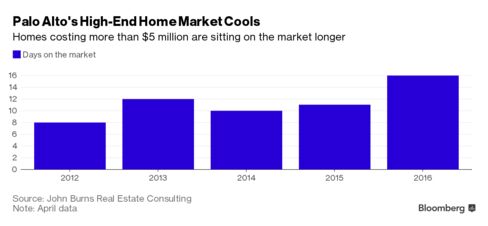
In Palo Alto, an ultra-wealthy city that’s home to many Google and Facebook Inc. executives, homes costing more than $5 million were on the market for a median of 16 days in April, compared with 11 in the same month in 2015 and 10 in 2014, according to data from Irvine, California-based John Burns Real Estate Consulting. The 11 active listings in that price range as of May 14 have been on the market a median of 30 days.


While that’s quick by most standards -- across the U.S., the median time on the market is 67 days -- it’s a departure from recent years, when newly minted millionaires from tech initial public offerings raced against buyers from China to scoop up anemic inventory.

“The seemingly inexhaustible well of very high-end buyers has proven exhaustible after all,” said Dean Wehrli, a senior vice president at John Burns. “The peak is behind us, and that’s becoming clearer and clearer to builders and buyers.”

Pricey Properties

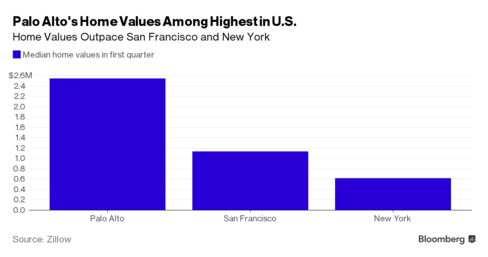
The San Jose metropolitan area, encompassing Silicon Valley, is the most expensive U.S. housing market, with a median single-family home price of $970,000, according to the National Association of Realtors. In Palo Alto, the median home price was $2.5 million in the first quarter, data from Zillow show. That’s higher than San Francisco, at $1.1 million, and New York, at $616,100.

Across the country, luxury-home sales are cooling as turmoil in the global economy and the prospect of higher interest rates roils financial markets. Silicon Valley has the added pressures of being closely correlated to the tech industry and a top target for foreign buyers.

Venture-capital investments in Silicon Valley fell almost 20 percent in the first quarter from a year earlier to $4.9 billion, according to an April report from PricewaterhouseCoopers LLP. Chinese buyers -- hit by a slowing economy and government restrictions on how much money can leave the country -- have slowed purchases after they had “really been driving the market,” said Woodson of Alain Pinel.

“We’re probably moving toward normalization,” said Katharine Carroll, vice president at Pacific Union Real Estate in Palo Alto. “Buyers see that they have a few more options. They don’t feel the urgency that they have to decide on something right away and put an offer in. They can kick the tires a little bit more.”

Statewide Slower

The sale of luxury real estate is slowing statewide, with homes costing more than $3 million sitting on the market 52.5 days in the first quarter, compared with 40 days the year before, said Jordan Levine, an economist at the California Association of Realtors in Los Angeles.

In Santa Clara County, home to Palo Alto, there were 13 sales of homes costing more than $5 million in the first quarter, down from 20 a year earlier, he said. In nearby Los Altos, there were six active listings of homes costing more than $5 million on the market for a median of 25.5 days as of May 14, while the 25 listings in Atherton were on the market a median of 100 days, according to John Burns.


“Given that a larger proportion of the $3 million-plus category is purchased with cash, or folks use some of their other assets to make those kinds of purchases, I think they’re more susceptible to stock-market volatility than your entry-level buyer would be,” Levine said. “That’s one of the big drivers of the current slowdown.”

Mid-Range Demand

There’s no let-up in the demand for homes in the $2 million to $3 million range. Realtors say those properties are still generating multiple offers and selling above asking prices because they are still affordable to software engineers. Aggressive hiring at Facebook and Google is propping up the middle segment of the housing market in Silicon Valley, said Ken DeLeon, founder of DeLeon Realty in Palo Alto.

“Palo Alto is at a crossroads, where some homes are doing very well, and some homes are lingering that last year would have sold with multiple offers,” DeLeon said. “When they do sell, it’s when the seller cuts the price below what they would have gotten last year.”

High-end buyers are pickier and are more likely to let a property go, instead of competing with multiple offers and an auction dynamic that led to homes selling well above asking price until very recently, he said.

“I’m having buyers who are much more open to waiting, to taking a risk that the home might sell,” he said. “There’s just not that motivation.”

Source: Bloomberg, Alison Vekshin
http://www.bloomberg.com/news/articles/2016-05-17/silicon-valley-mansions-linger-on-market-in-real-estate-slowdown

Friday, October 23, 2015

How Do Homeowners Accumulate Wealth?

How Do Homeowners Accumulate Wealth?

Lawrence Yun Contributor

Opinions expressed by Forbes Contributors are their own.


The differences between buying and renting are massive.  According to the Federal Reserve, a typical homeowner’s net worth was $195,400, while that of renter’s was $5,400.  The data reflects 2013 and the next survey of household finances, which is conducted every three years, will be out in 2016.

Based on what has happened since 2013 and projecting a conservative assumption of what could happen next year to home prices if we see only 3% price growth, the wealth gap between homeowners and renters will widen even further. The Fed is likely to show a figure of $225,000 to $230,000 in median net worth for homeowners in 2016 and around $5,000 for renters. That is, a typical homeowner will be ahead of a typical renter by a multiple of 45 on a lifetime financial achievement scale.

Though there will always be discussion about whether to buy or rent, or whether the stock market offers a bigger return than real estate, the reality is that homeowners steadily build wealth.  The simplest math shouldn’t be overlooked. A vast majority of homebuyers take out a 30-year fixed rate mortgage to make a home purchase. After 30 years, there is no mortgage payment (nor rent payment). So the home price growth over that time period would be the equity that the homebuyer would have accumulated. For example, the median home price of a single-family dwelling in the U.S. thirty years ago in 1985 was $75,500. This year, it will be at least $220,000. That figure of $220,000 is the housing component of the person’s wealth. Even had home prices not risen, the person would still have $75,500 in wealth today – on top of not paying any further monthly mortgage after 30 years.

This simple example does not play out nearly as neatly in the real world, since people do not stay in one residence over the 30 year period. Almost all homeowners trade up, change neighborhoods, or move to a better school district at some point. However, they are able to make those residential relocations due to the housing equity accumulated, even over a shorter period, and can immediately apply that equity to the next home as a downpayment. Therefore the conditions of steadily building housing wealth still hold.

We also know that not everyone can or should be homeowners. The memories of easily accessible subprime mortgages and subsequent harsh foreclosure pains are still fresh, and remind us of the devastating impact on the families involved, local communities, and to the broad economy. In addition most young adults have not developed the financial standing or have found a stable, desirable career and, therefore, choose not be homeowners until later.  The homeownership rate among households under the age of 35 is 35% currently and rarely rises above 40% historically. For those under the age of 25, the current ownership rate is 23% and rarely rises above 25%. But the time will eventually come when people want to convert to ownership. By the time people are in their prime-earning years of 45-to-55, nearly three-fourths do eventually become homeowners. By retirement, nearly 80% are homeowners.

A recent survey of consumers commissioned by my organization revealed that 80% believe that purchasing a home is a good financial decision (2015 National Housing Pulse Survey). Most consumers appear to already understand the simple math and the benefits of homeownership. So don’t overthink the matter of whether now is a good time to buy, or whether stock market returns will be better. The exact timing of a home purchase will have little financial impact in the big scheme of things. Just know that homeowners generally do come out ahead of renters in the long run.

Saturday, September 19, 2015

$100 million zombie homes may signal market top

An eight-acre waterfront estate in Kings Point, Long Island just hit the market for $100 million.
Homes listed for $100 million or more are piling up fast, but sales have ground to a halt, leading some to call a top in the very top of the real estate market.

Real estate brokers and analysts said there are roughly 20 homes for sale (either officially or unofficially) for $100 million or more in the U.S. That's up from about a dozen or 15 last year.

At the same time, sales of nine-figure homes have stalled. By the summer of 2014, three homes sold for $100 million or more. But so far this year, there hasn't been a single recorded sale at those prices, brokers and analysts said.
And as the inventory of super mansions rises, so have the price cuts—with some getting slashed by tens of millions of dollars.

Jonathan Miller, president and CEO of the Miller Samuel appraisal firm, said $100 million homes are largely "vanity listings," with owners setting prices "far detached from the market norm, the market conditions or the market price."

While some sellers may slap a blockbuster price on their homes to get marketing attention, the mega-prices have so far failed to generate sales.

"A $100 million price is just testing the market. But I don't know how much more testing they need to do," Miller said. "It's not working, this stuff isn't selling. Sellers are being extremely more aggressive and unrealistic than ever before."

Officially, there are only about seven or eight homes on the market in the U.S. that are priced at nine figures. The most recent is an eight-acre waterfront compound in Kings Point on New York's Long Island.

The property has 60,000 square feet of living space, 13 bedrooms, 35 bathrooms, an indoor lazy river, a two-story built-in doll house, a hair salon, wine room, indoor racquetball court, gym, saunas and a private pier than can hold a 200-foot yacht.

Yet Dolly Lenz, of Dolly Lenz Real Estate, said there are at least 20 homes for sale at $100 million or more when you include "whisper listings," those that are secretly for sale among high-end brokers, but not officially listed for buyers.

"These owners do not want pictures of their homes out there, and you have to show financial statements to tour the property," she said. "But there are a lot more $100 million homes out there than you think."

Lenz said that the lack of nine-figure sales is more a function of the quality of the specific listings than the result of any broader weakness in the luxury market.

"A property has to be super worthy to be sold for $100 million," she said. "But it doesn't have to be super worthy to be listed for $100 million. The buyers are the ones that matter and they haven't felt that any of these properties are worth it."

That's not to say that sales of $100 million homes have ended. Lenz said several new penthouses in New York that are coming online in the next few years will likely top $100 million. And a reported sale of the penthouse at 220 Central Park South will likely top the nine-figure mark when and if it closes.

But for now, hyper-priced homes have become the zombies of the luxury housing market—immovable and unchanging monuments to the hopes of super-rich sellers. And so far, those sellers are rarely budging.

"It seems like there is no shame to wildly over-pricing a property today," Miller said.

Granted, some sellers have shaved a little off their prices. Billionaire Jeff Greene this month cut the price of his Beverly Hills estate, called Palazzo di Amore, to $149 million from $195 million. He said the price cut was accompanied by several improvements to the house.

"We are very motivated to sell," Greene said.

Source: CNBC, Robert Frank
http://www.cnbc.com/2015/09/16/100-million-zombie-homes-may-signal-market-top.html

Tuesday, July 14, 2015

Obama Lauds HUD's New Fair Housing Rule

I wrote about this last week in my blog entry titled Government considering plan to force the poor in with the rich. If you haven't read it yet, maybe now you should. At the time I was under the impression that President Obama wasn't fully behind the plan, but now it looks like he is and it looks like it's going to happen sometime before he leaves office.


President Obama says the Fair Housing Act and the latest final rule issued by the U.S. Department of Housing and Urban Development will help ensure all Americans get an "equal shot in life." Obama devoted his latest weekly address to talking about the Fair Housing Act and battling discrimination in housing.

HUD last week issued a final rule on Fair Housing that aims to "equip communities that receive HUD funding with data and tools to help them meet long-standing fair housing obligations in their use of HUD funds." The rule aims to help local governments identify patterns of racial and ethnic discrimination. HUD will issue maps, charts, and other data showing racially or ethnically concentrated areas of poverty; the location of subsidized housing; and where wealthier people have access to greater community assets like top-notch schools and job opportunities.

"The work of the Fair Housing Act remains unfinished," Obama said. "Just a few weeks ago, the Supreme Court ruled that policies segregating minorities in poor neighborhoods, even unintentionally, are against the law. The Court recognized what many people know to be true from their own lives: that too often, where people live determines what opportunities they have in life. … In some cities, kids living just blocks apart lead incredibly different lives. They go to different schools, play in different parks, shop in different stores, and walk down different streets. And often, the quality of those schools and the safety of those parks and streets are far from equal – which means those kids aren’t getting an equal shot in life."

HUD's latest rule will aid communities in making sure the Fair Housing Act is in place.

"We're using data on housing and neighborhood conditions to help cities identify the areas that need the most help,"Obama said. "We're doing more to help communities meet their own goals."


Source: Realtor Magazine Online