Showing posts with label luxury. Show all posts

Wednesday, September 28, 2016

Why that million-dollar home is sitting on the market


By the time it sold last week for $4.8 million, a six-bedroom lakefront mansion in Winnetka had been on the market for most of the past six years and the sellers had already moved to California.

They're not the only high-end sellers who've had to wait: Luxury-priced homes all over the city and suburbs are taking a long time to sell.

Homes priced at $1 million and up are selling slower on average this year in 18 of 22 expensive Chicago neighborhoods and suburbs, according to Midwest Real Estate Data. Luxury homes are selling faster in just four locations: Streeterville in the city and in the suburbs of Evanston, Glencoe and Highland Park.

Agents blame an oversupply in the price range, reluctance of homeowners to head for the suburbs and the protracted struggle to clean up the financial mess in Illinois and Chicago.

"We've got these high property taxes, sales taxes and income taxes, and these crazy pension problems we'll never be able to pay for," said John Phillips, a Jameson Sotheby's International Realty agent in Winnetka. "Why buy an expensive house when you can buy a smaller one and use the rest of the money on something else, like a second home in another state?"

In Deerfield, where the slowdown has been steepest, the average home that went for $1 million or more in the 12 months ended July 31 sold in 233 days, up from 144 in the year-earlier period, MRED's data show.

Househunters in Deerfield "are seeing they can get a better deal in Highland Park," said Margie Brooks, a Baird & Warner agent with high-end listings in both Deerfield and Highland Park, to the east. "They get more of a downtown and the beaches."

Highland Park's better deals are available in part because so many homes are for sale there, which leads to price wars. There are 91 homes on the market at $1 million-plus in Highland Park, almost twice the 46 upper-end homes that sold in the previous year.

That should mean that Highland Park's high-end homes would be selling slower as well, but they're not.

In the city, the biggest slowdown is in North Center, where $1 million-and-up homes are selling in an average of 116 days this year, up 41 percent from the year before. There were 122 sales last year and 116 this year.

"It's because there's so much supply on the market," said Sean Glascott, an @properties agent. He sold a newly built home on Waveland Avenue in North Center that was on the market for 18 months before selling in June for slightly over $1.8 million.

While the 5,000-square-foot home was under construction, "there were 10 other homes being built in the immediate area, all within a couple hundred thousand dollars of ours, and we knew about more that were coming," Glascott said.

SALES UP

Although the time it takes to sell million-dollar-plus homes has lengthened this year, more of them are selling. This year, a combined 1,711 high-end homes have sold in the 22 areas, according to MRED, an increase of 3 percent from a year earlier.

Buyers may be coming for the prices. The Waveland Avenue home that Glascott sold started out at just over $2 million but eventually went for 13 percent less.

"We knew it was time to let this thing go before we were competing with 20 houses," he said.

Sales have slowed in city neighborhoods from the South Loop up to Lincoln Square. Only Streeterville has speeded up, but not by much. Million-dollar homes are selling in 140 days, down from 143 last year. But at the same time, the number of Streeterville sales is down 20 percent at 75 this year.

In the market overall, homes at all prices are selling faster than they were a year ago, according to MRED. While a single regional figure is not available that corresponds with the time period in the million-dollar study, MRED's end-of-August report showed that everywhere but Lake County had homes selling faster year-to-date than in the first eight months of 2015. In Lake County, they were selling 4 percent slower.

Evanston stands out as the bright spot for million-dollar sellers. Luxury homes are selling 35 percent faster—in 92 days this year, down from 142—and the number of sales, 45, is up 20 percent from last year.

"Evanston has always been a mini-Chicago," said Debbie Magnusen, an @properties agent who works there. "It has restaurants and culture; and if you want to go into the city easily, you can."

'THEY REALLY DON'T WANT TO GO FARTHER NORTH'

That's always been true, but Magnusen said it's become even more important in recent years as two-earner couples try to stay close to job centers and raise kids at the same time.

"They really don't want to go farther north," said Magnusen, who said listings in next-door Wilmette are getting considerably fewer showings than those in Evanston. High-end sales are taking 63 percent longer in Wilmette, an average of 101 days, up from 62 last year.

Agents in other, farther north suburbs have been saying the same recently: that younger affluent adults don't want to make longer commutes.

Phillips, the Jameson Sotheby's agent, said keeping to a shorter commute is a pragmatic choice the younger generation is making, in part because in these days of slow price recovery,

When home values "were going up 4 or 5 percent a year, you had the fun of living in it and made money at the end," Phillips said. "Now you can have a lot more fun with that money somewhere else, like Florida."

Source: Crain's Chicago Business, Dennis Rodkin
http://www.chicagobusiness.com/realestate/20160913/CRED0701/160919978/why-that-million-dollar-home-is-sitting-on-the-market

Thursday, June 16, 2016

Lagging Demand for Luxury Homes May Mean Deals for Buyers


forsale
A surplus of high-end homes for sale is giving more bargaining power to buyers.

In the U.S., the inventory of homes priced from $500,000 to $750,000 rose 15.9% in March compared with the same period last year, according to the National Association of Realtors. The inventory of homes over $1 million rose 12.6% year over year. Inventories dropped in April, likely due to the seasonal pattern of spring sales and perhaps some buyers taking advantage of deals, but real-estate agents say they are still seeing more expensive homes sit longer than midrange and lower priced homes.

Behind slowing sales at the upper level: Stock-market volatility has made wealthy buyers more cautious, and there are fewer foreign buyers than last year due to the dollar strengthening and other economic issues overseas, says Lawrence Yun, NAR’s chief economist.

“The stock market has come back up, but we don’t know yet if that means the upper-end home buying market will begin to return,” Mr. Yun says.

Year over year comparison of high-end home values.

What also could be happening is simply a “normalizing” of the home market, says Brad Blackwell, executive vice president and portfolio business manager for Wells Fargo Home Mortgage. That’s good for jumbo borrowers, who now have a wider choice of homes and won’t have to bend to sellers’ demands that waive financing and inspection contingencies to compete with cash buyers.

However, the thresholds for looser inventory differ widely by location as different market forces come into play. In suburban Hartford, Conn., homes priced between $300,000 and $450,000 are selling briskly, but listings of $600,000 to $800,000 often stall depending on location and whether they are priced reasonably, says Jessica Starr, agent/owner of Simsbury, Conn.-based Starr Realty, a team affiliated with Keller-Williams Realty. “A lot of people bought at the peak of the market [prerecession] and are taking a loss,” she adds.

Hartford is a good example of how local conditions impact the upper end of home sales. A number of big companies, including General Electric, are moving their headquarters from the area. That may create a glut in inventory, but other affluent, less geographically driven buyers, such as doctors, may swoop in for bargains in family friendly neighborhoods, Ms. Starr says.

In Portland, Ore., homes priced from $300,000 to $600,000 sell in five days with 10 to 20 offers, but listings start to sit on the market at $750,000 and get really challenged above $1 million, says Shannon Baird, a broker with Portland-based Living Room Realty. For example, a grand 1920s Tudor-style home with five fireplaces and a marble-floored ballroom was first listed at $1.6 million, but sat for five months and is finally set to close in June for $1.425 million, she says.

One of the biggest hurdles is changing the mind-set of homeowners attuned to quick sales and bidding wars, Ms. Baird says. One recent $840,000 listing had four counteroffers starting at $770,000 before buyer and seller agreed on $815,000. These days, Ms. Baird advises sellers to review their asking price and consider lower offers after 14 to 21 days.

In San Francisco, Maggie Visser, an agent with the San Francisco-based Paragon Real Estate, says stock-market gyrations have definitely slowed sales to tech-industry employees, many of whom cash out stock options to buy. Also slackening in the Bay Area is the market for newly constructed condo units, where sales had been driven by Chinese buyers, Ms. Visser says.

Here are a few things to consider when financing a more expensive home:

• Low interest rates. A bigger mortgage costs less now than it may in the future. Jumbo mortgage average interest rates are still near record lows—3.72% for the 30-year fixed rate and 2.87% for a five-year, adjustable-rate mortgage on the week ending June 10.

• More cash on hand. Lenders require higher down payments and more cash reserves as borrowers reach higher loan amounts, or “tiers.” For example, Wells Fargo will lend up to 89.9% on amounts up to $1 million, 80% on amounts between $1 million to $2 million, 75% on loans between $2 million and 2.5 million, and so on.

• Budget for all costs. Home buyers who are trading up should make sure they can also afford higher property taxes, homeowners’ insurance, and maintenance, Mr. Blackwell says. “It’s also always important for buyers of luxury houses to factor in the increased cost of furnishing that home,” he adds.

Source: Realtor.com, Anya Martin
http://www.realtor.com/news/trends/lagging-demand-for-luxury-homes-may-mean-deals-for-buyers/?iid=rdc_news_hp_carousel_theLatest

Friday, May 20, 2016

Silicon Valley Mansions Linger on Market in Real Estate Slowdown


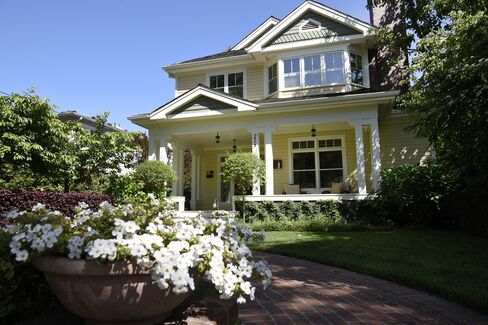
A custom-built home in Palo Alto.
A custom-built home in the heart of California’s Silicon Valley had its price cut by $500,000 last week after sitting on the market since the end of March -- a move that would’ve been almost unfathomable a year ago and a signal that frenzied demand has peaked.

The six-bedroom, five-bath house in Palo Alto -- located blocks from Stanford University and the homes of Google co-founder Larry Page and Steve Jobs’s widow, Laurene Powell Jobs -- is now listed for $7.5 million. It joins a growing inventory of high-end homes in the area that are taking longer to sell.

“We’ve recently noticed a slowdown,” Jack Woodson, who works at Alain Pinel Realtors in nearby Menlo Park, said on a tour of the house in the Old Palo Alto neighborhood. “Buyers are taking more time to decide about making offers.”

Silicon Valley, the most-expensive U.S. housing market, is seeing a pullback by the wealthiest homebuyers after a four-year real estate boom marked by bidding wars and multimillion-dollar prices. Stock-market turmoil, a drop in foreign investors and concerns of a technology-industry slowdown are cooling demand at the high end, even as interest remains robust for more moderately priced properties.

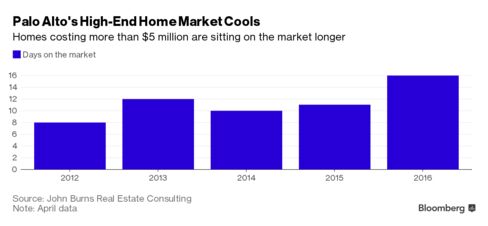
In Palo Alto, an ultra-wealthy city that’s home to many Google and Facebook Inc. executives, homes costing more than $5 million were on the market for a median of 16 days in April, compared with 11 in the same month in 2015 and 10 in 2014, according to data from Irvine, California-based John Burns Real Estate Consulting. The 11 active listings in that price range as of May 14 have been on the market a median of 30 days.


While that’s quick by most standards -- across the U.S., the median time on the market is 67 days -- it’s a departure from recent years, when newly minted millionaires from tech initial public offerings raced against buyers from China to scoop up anemic inventory.

“The seemingly inexhaustible well of very high-end buyers has proven exhaustible after all,” said Dean Wehrli, a senior vice president at John Burns. “The peak is behind us, and that’s becoming clearer and clearer to builders and buyers.”

Pricey Properties

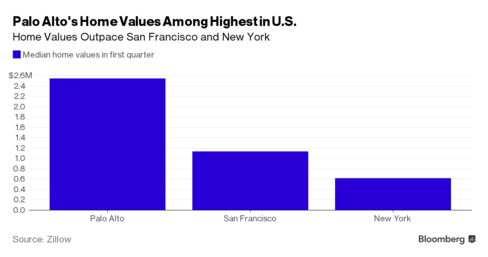
The San Jose metropolitan area, encompassing Silicon Valley, is the most expensive U.S. housing market, with a median single-family home price of $970,000, according to the National Association of Realtors. In Palo Alto, the median home price was $2.5 million in the first quarter, data from Zillow show. That’s higher than San Francisco, at $1.1 million, and New York, at $616,100.

Across the country, luxury-home sales are cooling as turmoil in the global economy and the prospect of higher interest rates roils financial markets. Silicon Valley has the added pressures of being closely correlated to the tech industry and a top target for foreign buyers.

Venture-capital investments in Silicon Valley fell almost 20 percent in the first quarter from a year earlier to $4.9 billion, according to an April report from PricewaterhouseCoopers LLP. Chinese buyers -- hit by a slowing economy and government restrictions on how much money can leave the country -- have slowed purchases after they had “really been driving the market,” said Woodson of Alain Pinel.

“We’re probably moving toward normalization,” said Katharine Carroll, vice president at Pacific Union Real Estate in Palo Alto. “Buyers see that they have a few more options. They don’t feel the urgency that they have to decide on something right away and put an offer in. They can kick the tires a little bit more.”

Statewide Slower

The sale of luxury real estate is slowing statewide, with homes costing more than $3 million sitting on the market 52.5 days in the first quarter, compared with 40 days the year before, said Jordan Levine, an economist at the California Association of Realtors in Los Angeles.

In Santa Clara County, home to Palo Alto, there were 13 sales of homes costing more than $5 million in the first quarter, down from 20 a year earlier, he said. In nearby Los Altos, there were six active listings of homes costing more than $5 million on the market for a median of 25.5 days as of May 14, while the 25 listings in Atherton were on the market a median of 100 days, according to John Burns.


“Given that a larger proportion of the $3 million-plus category is purchased with cash, or folks use some of their other assets to make those kinds of purchases, I think they’re more susceptible to stock-market volatility than your entry-level buyer would be,” Levine said. “That’s one of the big drivers of the current slowdown.”

Mid-Range Demand

There’s no let-up in the demand for homes in the $2 million to $3 million range. Realtors say those properties are still generating multiple offers and selling above asking prices because they are still affordable to software engineers. Aggressive hiring at Facebook and Google is propping up the middle segment of the housing market in Silicon Valley, said Ken DeLeon, founder of DeLeon Realty in Palo Alto.

“Palo Alto is at a crossroads, where some homes are doing very well, and some homes are lingering that last year would have sold with multiple offers,” DeLeon said. “When they do sell, it’s when the seller cuts the price below what they would have gotten last year.”

High-end buyers are pickier and are more likely to let a property go, instead of competing with multiple offers and an auction dynamic that led to homes selling well above asking price until very recently, he said.

“I’m having buyers who are much more open to waiting, to taking a risk that the home might sell,” he said. “There’s just not that motivation.”

Source: Bloomberg, Alison Vekshin
http://www.bloomberg.com/news/articles/2016-05-17/silicon-valley-mansions-linger-on-market-in-real-estate-slowdown

Wednesday, March 30, 2016

Two Silicon Valley Cities Amoung the Top 25 in The Nation


Palo Alto, Atherton crack top 10 priciest ZIP codes in U.S.

Atherton's 94027 code is No. 2 on the list, with a median sale price of $5,900,000 for 111 transactions last year. The fifth most expensive ZIP is in Palo Alto: The 94301 area includes downtown, Old Palo Alto and Crescent Park. The median price there was $3,150,000 for 157 sales in 2015, according to the PropertyShark website, which compiled the ranking.

All in all, 17 of the 25 most expensive ZIP codes are in California, seven in New York and one in New Jersey.

The list "pretty much tells you where the rich people live," said Nancy Jorisch, PropertyShark's data research manager. "It's the two coasts. And actually, now it's heavily California."

The No. 1 spot on the list is occupied by New York's Sagaponack, in the Hamptons, where the median was $8,500,000, though only five sales were recorded in that exclusive community.

Also on the list are Los Altos (94022, No. 12 on the list; and 94024, No. 14 on the list); Portola Valley (94028, at No. 15); San Francisco (94123, in the Marina District, at No. 16); Palo Alto again (94306, No. 22); Burlingame (94010, No. 24) and Saratoga (95070, No. 25).

Any surprises?

"None at all," said Palo Alto-based Sereno Group real estate agent Alex Wang. "We've had so much appreciation in Bay Area real estate. A high tide lifts all boats, and as Palo Alto and Altherton go up, the surrounding areas go up as well."

Just look at Burlingame. The median price there was $2,215,000 for 415 sales, the most transactions among the top 25 ZIP codes. Total sales volume exceeded $1.1 billion.

"Burlingame has become like the Palo Alto of the north," Wang said. "It's that next place down (from San Francisco) -- beautiful downtown, very vibrant, has good schools and a lot of local amenities, a good option for families."

Incidentally, Beverly Hills' iconic 90210 placed third.

However, Mountain View and Menlo Park failed to crack the top 25, despite their proximity to Google and Facebook. Jorisch said she suspects that the many condo and townhouse sales in those communities brought down the overall median sale prices.

As an example, Mountain View's 94040 ZIP code (No. 58 on the list) had a measly median of $1.5 million.

Meanwhile, Menlo Park's 94025 (No. 37) had a $1.84 million median, still a pittance, comparatively speaking.

There's always next time.

Source: Mercury News, Richard Scheinin
http://www.mercurynews.com/business/ci_29699948/palo-alto-atherton-crack-top-10-priciest-zip

Thursday, December 24, 2015

Foreclosures Just Got Way Fancier: How to Score a Deal on a Luxury Home

foreclosure

Think foreclosed homes are always ramshackle properties with overgrown lawns, boarded-up windows, and hordes of squatters? On the contrary, they can also be mansions on the beach or stately apartments at the top of a Four Seasons Hotel that, even in their “distressed” state, are worth well into the six figures.

In fact, foreclosures priced at more than a $1 million have been in such high demand lately, they’ve been creating bidding wars and selling at a premium.

So what’s the story behind these high-end abandoned abodes? Many represent strategic choices by homeowners to walk away from an underwater investment property. Because these owners often have more than one place, they don’t have as much of an emotional connection to each one.

“Luxury owners view it as a business decision and not as much as a personal failure,” says Bruce Ailion, an Atlanta-based Realtor® and attorney. It’s a business decision for them, but an opportunity for you!

But buying a foreclosure, especially a high-end one, isn’t for the faint of heart, since its high price tag makes it a heftier risk. So if you’re curious about what it takes, here are some tips on doing it right—and some current listings that will get you salivating.

Weigh repairs and improvements carefully

Even high-end homes have flaws that must be fixed. And while banks will typically make repairs and improvements to luxury foreclosure homes before listing them, they may make low-cost fixes that could conflict sharply with the character and value of the home—so keep an eye out for things such as cheap carpet or crummy appliances. Also, try to get an inspector with experience in the luxury market.

“Just as you would not have your Ferrari worked on at the corner garage, you should not choose just anyone to evaluate a complex home,” Ailion says. And if you or an inspector finds an issue, know that banks are less likely to pay for it than to give you a discount to take care of it. “Banks typically want to sell these properties as is,” Ailion says. And the more high-end or custom a home, the more expensive those repairs will be.

Skip the lowball offer

The days of getting a 50% discount on a property because it’s bank-owned have passed. If the home is in good condition—as luxury homes tend to be—you’ll likely be competing with investors and all-cash offers.

“Banks are a lot less motivated to make deals happen than they were in 2008, when they just wanted to get things off their books,” says Ryan Wright, CEO of DoHardMoney.com, which provides financial services to fix-and-flip real estate investors. In fact, this year foreclosures worth more than $1 million were selling at an average of 3% above asking price!

Bottom line: If you have your eye on a home, know that haggling too hard may get you knocked out of competition.

But don’t overpay, either

While lowball offers don’t behoove you, neither does overpaying. So don’t get sucked into going over budget to win the property.

“Oftentimes there are bidding wars on these properties, and we’ll see buyers pay upward of $600,000 more than what the list price is,” says Alexandria Carlson, an associate broker with Engel & Volkers in Scottsdale, AZ. Know what your limit is, and stick to it: Foreclosure or not, if you end up paying more than the property is worth (or than you can afford), you’re getting a bad deal.

Find the right Realtor(s)

Since there’s a ton of extra paperwork involved with buying a bank-owned property, smooth the process by working with a Realtor® experienced in foreclosures. And since luxury properties have their own peculiarities, you’re best off getting someone with experience in both areas: foreclosures and the luxury market. And if you can’t, consider hiring two agents that can work as a team for you and split the commission.

Here’s a sample of some of the high-end foreclosures available now:

451 Mashta Drive, Key Biscayne, FL

List price: $8.9 million

This nine-bedroom, seven-bathroom, Mediterranean-style estate is on the water with a private dock and ocean access.

An $8.9 million Mediterranean-inspired estate in Key Biscayne, Fla.

132 E. Delaware Place, Apt. 6302, Chicago, IL

List price: $5.9 million

This 7,000-square-foot duplex has stunning city views and is located at the top of the Four Seasons Hotel—easily near fine dining.

lfbe31945-m3xd-w640_h480_q80

12 Horizon, Newport Coast, CA

List price: $4.9 million

This 7,400-square-foot residence in Pelican Hill Estates has six bedrooms and 7.5 bathrooms. And check out that pool!

lce94fb44-m0xd-w640_h480_q80

50 Bellevue, Ave., Piedmont, CA

List price: $3.9 million

In addition to five bedrooms and 4.5 bathrooms, this home has a library and ballroom—what debutante could resist?

l4bbe4045-m0xd-w640_h480_q80

2515 Mercedes Drive, Fort Lauderdale, FL

List price: $3.5 million

This waterfront, four-bedroom, 7,700-square-foot home needs work, but it has a private boat dock and an elevator. Apparently, stairs are optional in this multimillion-dollar home!

l70046445-m0xd-w640_h480_q80

Source: Realtor.com, Beth Braverman

Friday, May 1, 2015

A Mega Condo Project in Milpitas Set to Rise

Almost everywhere I go here in the Silicon Valley I see new construction going up, and Milpitas is no different. It looks like some developers have gotten the approval for a luxury, mixed use high rise set to break ground next year sometime for completion in 2018. This is another example of the overall economic prospect for this area when you have major investors willing to sink money into a housing project here. They wouldn't do so if the economic forecast here looked pretty bleak.

A Mega Condo Project in Milpitas Set to Rise
Milpitas, BDK Capital Group, Landmark Milpitas, Singpoli Capital Corp., American BD, MVE+Partners, Silicon Valley, condo

BDK Capital Group LLC plans to break ground next year on an approximately $300 million mixed-use project featuring 450 luxury condominiums in Milpitas.

The Landmark Tower is outlined as two 18-story buildings featuring for-sale condos above roughly 34,000 square feet of ground-floor commercial space at 600 Barber Lane, the site of a former Chevrolet dealership.

Arcadia, Calif.-based real estate investment and development group Singpoli Capital Corp. and joint venture partner American BD, which comprise BDK, purchased the entitled three-acre site for $21 million in November from Pham Co. LLC, said William Chu, CFO at Singpoli.
The site was entitled for an up to 760,000-square-foot mixed-use project in 2008, and Singpoli is looking to gain city approval to “fine-tune” the design by bumping up the number of condo units from 375 to 450 and reducing the commercial space, Chu said. The property also will include 1,240 parking spaces.

“It’s a high-quality design,” said Edesa Bitbadal, the city’s economic development director. “It speaks to the direction the City of Milpitas is going,” adding that more millennials and technology employees are moving into the city and seeking housing with “better services and amenities.” The city expects full-service restaurants will occupy the commercial space, she said.

Irvine, Calif.-based architecture firm MVE+Partners is designing the project, which will include eight four-bedroom penthouse units along with a rooftop deck, lounges, fitness center, pool and community room. The project design gives it “an exclusivity and [feel of the] New York lifestyle in Silicon Valley,” Bitbadal said.

Landmark Tower, slated to open in 2018, will be near a local bus route and about one mile from a light-rail station. Also nearby is Cisco Systems, Inc., Milpitas Square shopping mall—featuring many Asian eateries—Asian-American grocery 99 Ranch Market, Wal-Mart, the planned Pacific Mall, and the new Levi’s Stadium, home to the San Francisco 49ers. It also will be near the BART station, scheduled to debut in 2018.

The project will be Singpoli’s first development outside of Southern California. Milpitas fits into its strategy of investing in growing markets, Chu said. He also noted that the company liked the city’s demographics, with a median age of 32 years old and median family income of $103,000, based on 2013 statistics.

The Silicon Valley city, also home to companies such as electronics manufacturer Flextronics and manufacturing firm KLA-Tencor Corp, is easily accessible to Interstates 880 and 680 and Highway 237

Milpitas is garnering much interest from developers and has 7,000 residential units under consideration or in the works, Bitbadal said.

“The city has done its share in developing housing for residents and providing it regionally—we have welcomed it,” Bitbadal said.

In Southern California, Singpoli recently renovated a historic Pasadena hotel into the 130-key upscale boutique DusitD2 Hotel Constance and is now co-developing a 159-room Marriott Courtyard and 129-rom Marriott Residence Inn in Marina Del Rey. Singpoli began as a construction company in Hong Kong in 1977.


Source: Nancy Amdur, TheRegistry
http://news.theregistrysf.com/a-mega-condo-project-in-milpitas-set-to-rise/